The Most Effective Insulation for Metal Buildings and Steel Frame Structures
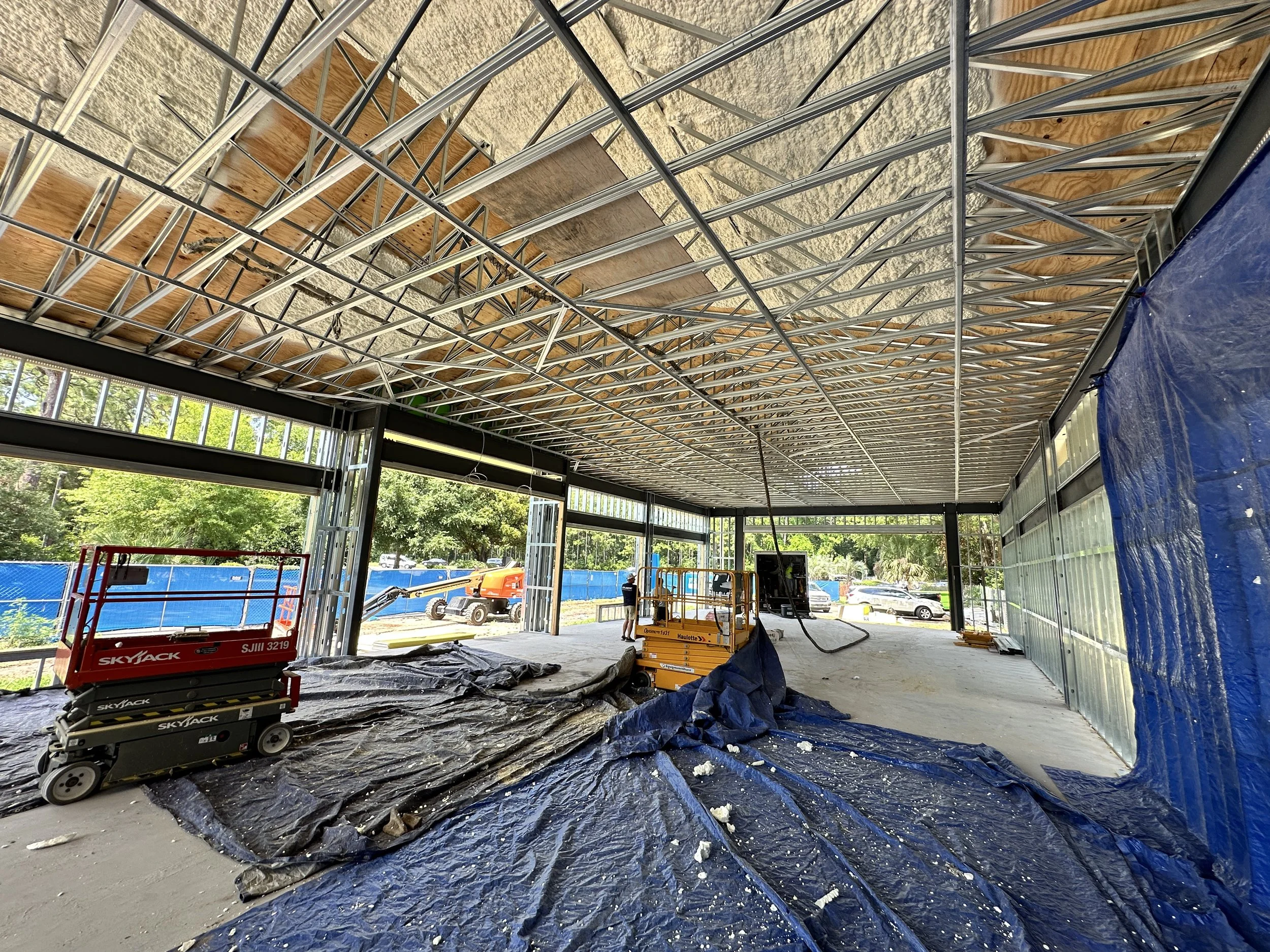
If you own a metal building anywhere from Hilton Head to Charleston, you’ve likely battled roasting interiors on summer afternoons, dripping “sweat” from the roof on cool mornings, and the persistent mustiness that comes with high humidity. Coastal South Carolina’s sun, sea air, and high dew points make condensation and heat gain relentless - unless you choose an insulation strategy built for steel and for this climate.
The right answer pairs enough thermal resistance with continuous control of air and vapor. In practice, that often means using closed-cell spray foam to seal steel members and panel backs, then adding cavity or continuous insulation to hit your R-value target. In this guide, you’ll see clear numbers - R-value bands, perm ratings, and cost ranges - plus practical installation details for C-channels, hat channels, rooflines, and wall assemblies. If you’re planning a pro install, Atlantic Spray Foam specializes in steel-frame projects across coastal South Carolina and nearby Savannah.
Key takeaways
In hot-humid coastal zones, the best-performing assemblies pair sufficient R-value with continuous air and vapor control to stop condensation on steel skins.
Closed-cell spray foam leads for sealing steel frames - filling gaps at C-/hat channels, rooflines, and wall assemblies - while meeting R-value targets in fewer inches.
Reflective layers can cut radiant heat but need air gaps and don’t deliver high R-values alone; use them as supplements, not primary insulation.
Expect ballpark installed costs to span from budget fiberglass to premium insulated metal panels; plan choices using per-square-foot ranges before value engineering.
For moisture-safe performance, choose low-perm facings or foams and install a defined vapor retarder where required (perm 0.02–0.9 options exist).
What insulation works best for metal and steel-frame buildings in coastal climates?
Start with a closed-cell spray foam layer to create a continuous air and vapor control at steel members and panel backs, then add cavity or continuous insulation as needed to reach R-13–R-30 targets for walls and roofs. This approach directly addresses coastal South Carolina’s heat and humidity by stopping humid air from leaking through laps, fasteners, and channels that otherwise drive interior condensation when night-time skin temperatures drop below the dew point.
Aim for assemblies in the 3 - 6 inch thickness range when balancing energy efficiency and moisture protection in most occupancies; tune thickness and R-value within the R‑13 - R‑30 band by use and code. If you choose another path (like fiberglass blankets or rigid boards) pair them with a defined vapor retarder and meticulous air sealing, and pay special attention to bridging at girts and purlins. Doing so helps keep surface temperatures above dew point and stabilizes both temperature and humidity inside.
Why metal buildings along the South Carolina coast struggle with heat, humidity, and corrosion
Coastal South Carolina brings high outdoor dew points and salt-laden air that raise interior moisture loads. When night sky cooling drops metal skins, water vapor condenses on cold steel unless air and vapor flow are controlled. Inside metal buildings, thermal bridging at girts, purlins, and fasteners bypasses blanket insulation, creating cold stripes that can “rain” indoors. This bridging is a known weakness of fiberglass-only approaches without continuous control layers.
Undershooting R-value makes temperature swings worse at the steel skin. For most local workshops, warehouses, and light commercial uses, assemblies commonly target R‑13–R‑30 in walls and roofs to reduce those swings. A defined vapor retarder on the warm-in-winter side (selected within the 0.02–0.9 perm range) further limits moisture drive into the assembly, reducing corrosion risk at steel interfaces. Combine these moves and you cut off the three big drivers of damage: humid air leakage, cold-surface condensation, and salt-assisted corrosion.
How spray foam solves steel-frame details (C-channels, hat channels, rooflines, wall assemblies)
Closed-cell spray foam is applied as a liquid that expands in place up to 120 times its volume, so it chases down leaks and seals around channels, flutes, laps, and fasteners that otherwise admit humid air and vapor. Because it adheres to steel skins and framing, the cured foam forms an integral air and vapor control layer right where you need it: at the panel backside and along the steel.
Targeted passes at C‑channels and hat channels create a monolithic layer that reduces thermal bridges and moisture pathways. It’s also ideal for insulating these members and won’t corrode metal studs. Since continuity at transitions (ridge, eaves, base girt, penetrations) determines performance, professional installation is the standard for results you can count on. In practice, the production efficiency is high: a typical mid‑size metal building around 2,500 square feet can be insulated in less than a day, minimizing downtime. Explore the single-application steel-frame service in more detail at Atlantic Spray Foam’s steel-frame construction page.
Compare your options: spray foam vs fiberglass vs rigid foam vs IMPs vs reflective layers
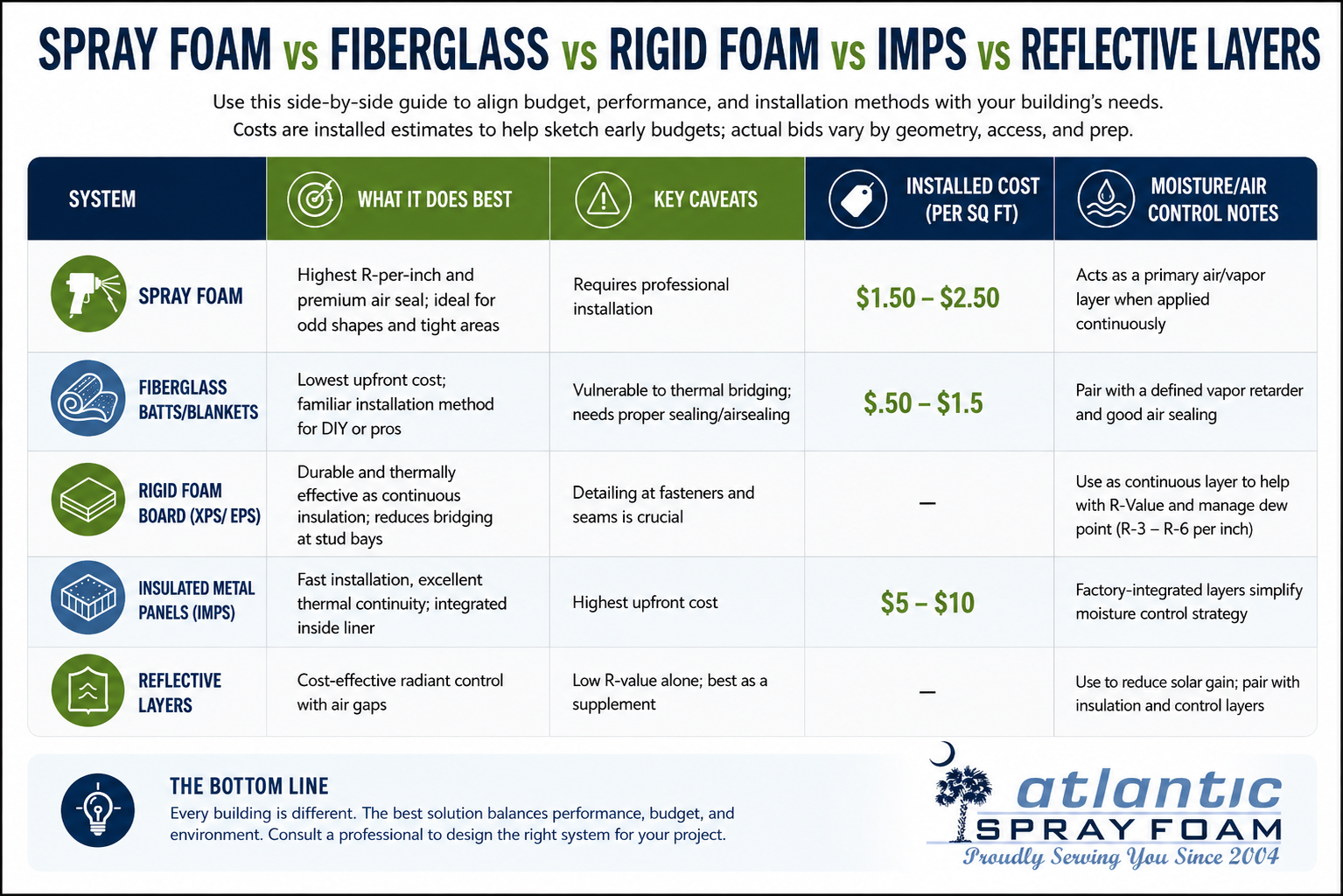
Use this side-by-side to align budget, performance, and installation method with your building’s needs. Costs are installed ballparks to help sketch early budgets; actual bids vary by geometry, access, and prep.
Notes
Fiberglass’s susceptibility to thermal bridging makes it a weaker choice alone at steel frames. If selected, protect it with low-perm facings and tight air sealing.
Reflective layers help with radiant loads but don’t deliver high R-values on their own; use them as add-ons in hot roofs rather than as the primary insulation.
For closed-cell spray foam, professional installation is recommended to achieve the continuous, safe, code-aligned result steel buildings require.
R‑values, thickness, and perm ratings: what the numbers mean for steel buildings
Treat R-value as the thermal resistance target for comfort, condensation control, and energy use. In metal-building assemblies, common targets span R‑8 to R‑30; confirm local energy code and your building’s occupancy to choose the right number. For balanced energy efficiency and moisture protection, many successful assemblies land at 3–6 inches of insulation, with higher setpoints, denser occupancies, or cooled storage pushing you to the upper end of the range.
If you’re considering fiberglass, representative reference points are R‑7 at 2 inches and R‑19 at 6 inches, with performance highly dependent on proper facings and intact air barriers in humid zones. Loose fill typically provides about R‑3 to R‑4 per inch and belongs in enclosed cavities rather than exposed purlin or panel conditions. On the moisture side, select a defined vapor retarder within the 0.02–0.9 perm band based on interior conditions and your intended drying direction. In hot-humid coastal climates, the combination of low-perm control and airtightness at the steel skin is your best defense against dew-point condensation.
Budgeting and phasing your project
Start with known, installed cost bands to plan your budget, then refine with final field bids:
Fiberglass batts/rolls: $0.5–$1.5 per square foot
Closed-cell spray foam: $1.5–$2.5 per square foot
Insulated metal panels (IMPs): $5–$10 per square foot
For retrofits, a proven sequence is to first establish the continuous air and vapor control - often with closed-cell foam at the roof underside and wall panel backs - then add cavity or continuous insulation to reach R‑targets in the R‑13–R‑30 range. This phasing immediately tackles condensation and humidity while giving you a path to fine-tune energy performance. If you’re ready to line up qualified help in Bluffton, Beaufort, Hilton Head, Charleston, or Savannah, connect with local spray foam insulation contractors near Hilton Head, Beaufort and Bluffton, SC.
Finally, plan for speed: single-application foam systems can cover around 2,500 square feet in less than a day, which limits operational disruption in working shops or warehouses.
Installation playbook for steel buildings: rooflines and walls
Delivering stable temperature and humidity in a steel building comes down to continuity. Here’s how pros sequence the work.
Preconditions: Do not cover active leaks, standing water, or rot. Address bulk water and existing moisture issues first so you don’t trap moisture in the assembly. For considerations in older structures and humidity-sensitive builds, see this guidance on spray foam in older and historic homes in Charleston and Savannah.
Rooflines: Spray foam to the underside of roof panels and across purlins to form the primary air/vapor layer. Maintain continuity across ridge lines, hips, eaves, skylights, and all penetrations. Professional installation is recommended to achieve consistent coverage and safe application at height.
Walls: Start at the base girt and continue up, sealing around C‑/hat channels, panel laps, and fasteners to create a monolithic layer. Add continuous boards or interior liners as needed to reach your R‑value target within the R‑13 - R‑30 band while preserving the air/vapor control layer you’ve established at the steel.
Facings/retarders: If you’re using blanket or liner systems, select facings within the 0.02 - 0.9 perm range to limit vapor drive in humid seasons and coordinate the retarder location with your drying strategy.
For single-application coverage that reaches channels and irregularities, review the workflow on Atlantic Spray Foam’s steel-frame construction page.
Frequently Asked Questions
Is reflective “double bubble” enough on its own?
No. Use reflective or “double bubble” layers as a supplemental radiant barrier, not as the primary insulation. By itself it doesn’t provide high R-values, though some marketed products list R-ratings for walls and ceilings when installed with the required air spaces. In coastal conditions, you’ll still need bulk insulation and a clear air/vapor control strategy to prevent condensation.
What R‑value should I target for a workshop or warehouse near the coast?
Most buildings aim for assemblies in the R‑13 to R‑30 range for walls and roofs. Choose within that band based on your interior setpoints, occupancy, and local code.
Can I DIY spray foam in a steel building?
It’s not recommended. Spray foam requires professional installation to achieve a consistent air and vapor seal, proper adhesion to steel, correct thickness, and safe application around rooflines and framing.
How fast can a typical mid‑size metal building be insulated?
Single-application foam installations can insulate around 2,500 square feet in less than a day in many cases. Exact timing depends on access, substrate prep, and sequencing with other trades.
References
Every figure in the article must come from this list. Edit or remove anything you don't trust; the writer never invents numbers.
[1] A reflective double-bubble product lists R-6 on walls and R-10 on ceilings when installed with air spaces.: "It’s a reflective vapor barrier that helps prevent condensation while also offering thermal performance: R-6 on walls and R-10 on ceilings." (unitedmetalbuildings.us)
[2] Common metal-building insulation assemblies span R-8 to R-30.: "R-values for metal building insulation range from R-8 to R-30." (therm-all.com)
[3] Commercial vapor retarders are available with perm ratings from 0.02 to 0.9.: "Vapor retarders are currently available with perm ratings ranging from 0.02 to 0.9." (therm-all.com)
[4] Spray foam insulation should be installed by professionals.: "spray foam requires professional installation and comes at a higher cost." (rmax.com)
[5] Fiberglass batt systems are susceptible to thermal bridging.: "it is susceptible to thermal bridging, where heat escapes through gaps around the insulation." (rmax.com)
[6] Reflective insulation alone does not provide high R‑values.: "While it doesn't offer high R-values on its own, its ability to reduce heat gain makes it valuable for specific applications." (rmax.com)
[7] Typical installed cost range for fiberglass batts/rolls in metal buildings.: "Fiberglass batts or rolls: $0.5 - $1.5 per square foot" (buildingsguide.com)
[8] Typical installed cost range for spray foam insulation in metal buildings.: "Spray foam insulation: $1.5 - $2.5 per square foot" (buildingsguide.com)
[9] Typical installed cost range for insulated metal panels (IMPs).: "Insulated metal panels: $5 - $10 per square foot" (buildingsguide.com)
[10] Reference R‑value for 2-inch fiberglass insulation.: "2" | R-7" (buildingsguide.com)
[11] Reference R‑value for 6-inch fiberglass insulation.: "6" | R-19" (buildingsguide.com)
[12] Loose fill insulation delivers approximately R-3 to R-4 per inch.: "Loose-fill insulation has an R-3 to R-4 value per inch." (buildingsguide.com)
[13] A practical thickness target for energy efficiency and moisture protection is 3–6 inches.: "Aim for 3–6 inches of insulation to achieve good energy efficiency and moisture protection." (peb.steelprogroup.com)
[14] Typical R‑value targets for metal-building walls and roofs are R‑13 to R‑30.: "typically R-13 to R-30 is ideal for walls and roofs." (qebuildings.com)
[15] Compared with fiberglass, spray foam offers better air sealing and insulation value.: "Spray foam offers better air sealing and insulation value, but fiberglass is more budget-friendly." (qebuildings.com)
[16] Atlantic Spray Foam can insulate a 2,500 sq. ft. building in less than a day.: "Because they are a single-application permanent solution, a 2,500 sq. ft. building can be insulated in less than a day, saving time." (atlanticsprayfoam.org)
[17] Atlantic Spray Foam’s product expands up to 120 times its volume when applied.: "These products are sprayed as a liquid expanding up to 120 times the volume within seconds." (atlanticsprayfoam.org)
[18] Spray foam is ideal for insulating hat channels and C‑channels and won’t corrode metal studs.: "It is ideal for insulating hat channels and C-channels and won't corrode metal studs." (atlanticsprayfoam.org)