You ask for proposals for a crawl space or insulation project and receive different totals. Each sounds like it addresses the same problem, so why does one cost more? The useful comparison is not the final number alone. It is the treated area, preparation, material specification, and moisture-control work behind that number.
Insulating framing and encapsulating a crawl space solve related but distinct problems. Foam installation may address insulation and air leakage, while encapsulation brings the ground, walls, vents, and moisture conditions into the project. Comparing those scopes as though they were interchangeable can make a reasonable quote look expensive or an incomplete proposal look attractive. [5][6]
Atlantic Spray Foam uses property-specific quotes to connect your budget to your home’s needs. Understanding the proposed installation, any additional work, and the potential operating savings helps you decide what you are buying.
Key takeaways
Atlantic Spray Foam prices the property and project. Its quotes account for square footage, foam type, and whether the work involves new construction or a retrofit.
Crawl space insulation and full encapsulation are different purchases. Compare the surfaces treated and moisture-control work included, not just the totals. [5][6]
Preparation matters. Existing insulation removal, restricted access, damp materials, and repairs can explain differences between similar-sized homes.
Coastal water conditions can broaden the scope. Drainage and flood-related requirements address problems that insulation alone does not solve.
Energy-savings percentages need a defined baseline. EPA estimates that air sealing homes and adding insulation in attics, floors over crawl spaces, and accessible basement rim joists can save an average of 15% on heating and cooling costs or an average of 11% on total energy costs. [4]
How does Atlantic Spray Foam price a home insulation project?
Atlantic Spray Foam tailors quotes to square footage, foam type, and whether the project is new construction or a retrofit. The starting question is what needs treatment, not simply how large the house is.
For budgeting, Atlantic Spray Foam’s average roof deck job is between $5k to $8k, while new construction is between $12k to $20k.
For crawl spaces, Atlantic Spray Foam’s average full encapsulation is $15k, while closed-cell foam alone is $6k to $9k.
These figures encompass a wide range of factors situations and consideration, There is simply not an interchangeable way to price the different installations.
A roof-deck project treats a defined part of the home. Crawl space insulation addresses the specified framing or enclosure surfaces. Full encapsulation includes a broader moisture-control scope. New-construction work can involve insulation across more of the building. A whole-home total and a limited-area total therefore represent different quantities of work, even when both use spray foam.
For homeowners in Bluffton, Hilton Head, Beaufort, and Charleston, Atlantic Spray Foam’s consultation and detailed quote connect comfort, moisture, and insulation concerns to a defined project.
That written scope is what makes the price meaningful.
What is the difference between crawl space insulation and full encapsulation?
Crawl space insulation and encapsulation overlap, but they do not perform identical jobs. Atlantic Spray Foam’s crawl space service uses closed-cell foam to seal wood crevices and band boards, while reinforced vapor-barrier lining isolates the home from damp earth. [5][6]
Foam at framing addresses the specified insulation and air-sealing work. A reinforced liner addresses moisture coming from the ground. Encapsulation connects those concerns into an enclosure strategy rather than treating one surface in isolation. [5][6]
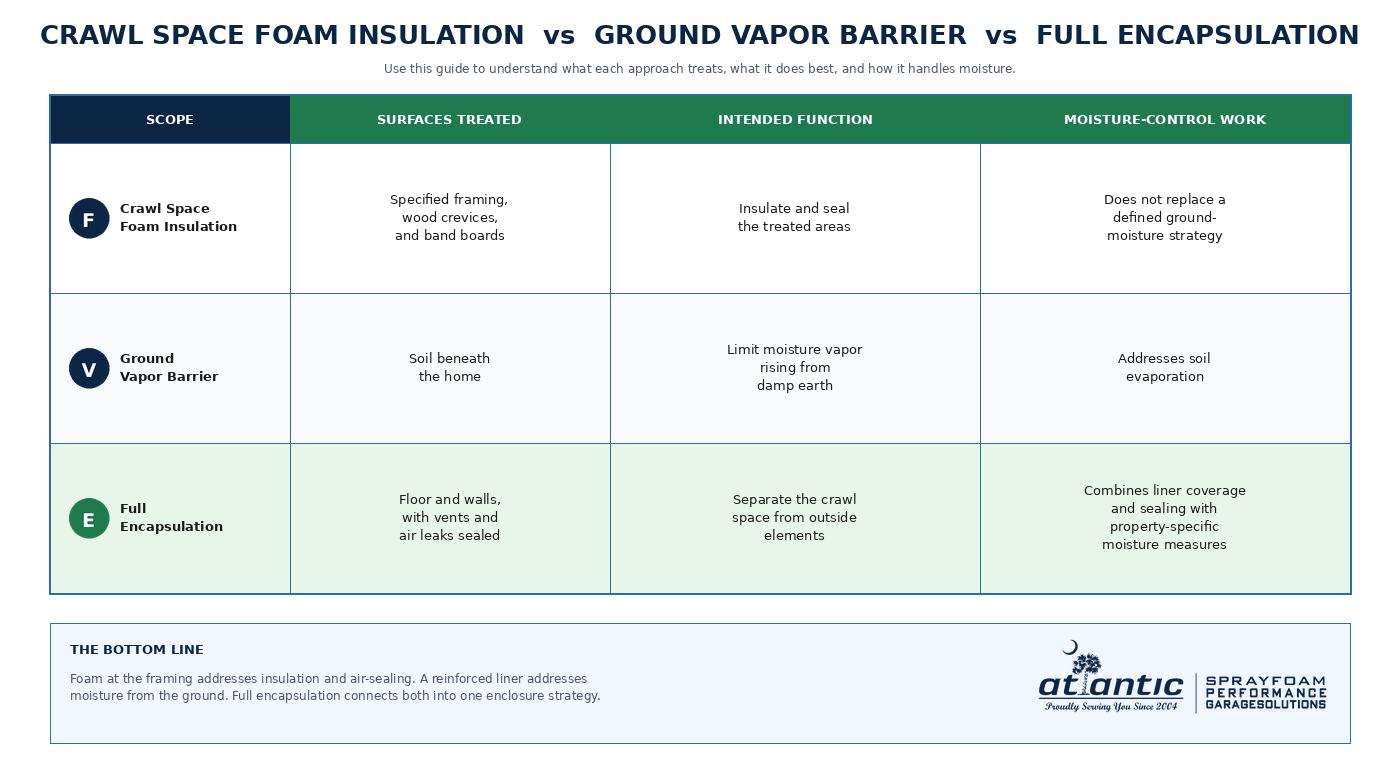
Atlantic Spray Foam describes encapsulation as installing a vapor barrier on the floor and walls, sealing vents and air leaks, and possibly adding insulation. Atlantic Spray Foam’s crawl space insulation and encapsulation services can improve energy efficiency by helping keep indoor air at a more consistent temperature. [5][6]
Depending on the property, drainage matting, access improvements, air filtration, and moisture removal can expand the scope. A ground barrier alone addresses soil evaporation; a complete enclosure also addresses incoming humid air. That distinction explains why “vapor barrier installed” and “full encapsulation” should not be treated as equivalent descriptions. [5][6]
Why can similar-sized homes receive different insulation quotes?
Floor area is only part of the material calculation. The coverage area and application thickness work together to determine how much foam is required. A board foot is one square foot of coverage at one inch thick. Proposals with different thicknesses can therefore involve different material quantities despite treating the same square footage area.
Material selection also matters. Atlantic Spray Foam installs open-cell spray foam in walls, floors, ceilings, and attics for air sealing and sound absorption. Closed-cell applications serve situations requiring greater moisture resistance. A useful proposal identifies the foam type and its intended application rather than saying only “spray foam.” [1][2]
Preparation can create another substantial difference. The type of existing insulation that needs removal and the amount of square footage being installed both affect Atlantic Spray Foam’s pricing. Debris disposal, damp materials, and damaged substrates add work before installation can begin. A proposal that includes this preparation is not equivalent to one covering application alone.
Access and framing affect installation effort, too. Restricted crawl spaces and complicated framing require a different approach from open, accessible surfaces. Likewise, installing before drywall differs from retrofitting finished spaces while protecting original interior details.
When weighing spray foam insulation against traditional fiberglass, keep the comparison tied to the intended result and complete installation scope. The material name alone does not explain the price. [1][5]
How do Bluffton, Hilton Head, Beaufort, and Charleston conditions affect cost?
Regional estimates provide useful budgeting context, but they do not replace a property-specific quote. Charleston and Lowcountry encapsulation projects are estimated at $6,000-$14,000, with historic homes costing more due to foundation complexity. A Hilton Head / Beaufort 1,200 sqft crawl space encapsulation project is estimated at $6,200–$11,000.
These regional estimates and Atlantic Spray Foam’s project averages describe different sets of work. They are useful starting points, not evidence that every proposal should land at the same total.
Coastal conditions help explain the variation. Many Lowcountry parcels sit within 2–4 ft of the seasonal water table. High water tables, storm exposure, salt-air corrosion, and historic foundations can broaden the work needed beyond installing insulation or laying a liner.
Standing water requires attention separately from moisture vapor. Drainage planning addresses where liquid water goes; a vapor barrier addresses moisture rising from the ground. Adding a sump pump to a South Carolina encapsulation project costs $800-$1,500. Whether that equipment belongs in the design depends on the property’s water conditions.
Permits and engineering also belong in the scope discussion. Building permits are required in most South Carolina jurisdictions for structural work and drainage, while vapor barrier installation alone is generally permit-exempt. South Carolina coastal flood-zone properties may need engineering review.
For a Bluffton homeowner, the practical questions are the same as elsewhere in the Lowcountry: What access is available? What insulation is already present? Is there active water intrusion? Are repairs needed? Those conditions make a local quote useful, rather than a location label attached to a generic price.
How much can spray foam lower your electric bill?
Reducing air leakage and heat transfer can reduce heating-and-cooling demand. Atlantic Spray Foam installs liquid-applied foam that expands to insulate and air-seal building cavities, addressing both concerns within the treated areas. [1]
For older homes, Atlantic Spray Foam identifies potential inside electric cost reductions of 20% to 50%, excluding pools and other unrelated electricity uses. That potential should not be read as a guaranteed reduction in the entire utility bill. The home’s starting insulation, air leakage, climate, and project coverage influence the opportunity.
A broader benchmark helps put savings claims in context. EPA estimates that air sealing homes and adding insulation in attics, floors over crawl spaces, and accessible basement rim joists can save an average of 15% on heating and cooling costs or an average of 11% on total energy costs. [4] These estimates describe air sealing plus insulation in existing homes, not a guaranteed result from a particular spray foam project.
EPA assumed that cost-effective air sealing would achieve a 25% reduction in total air infiltration by focusing on leaks to the attic, through the foundation, and around windows and doors. [4]
The denominator matters. Heating-and-cooling spending is only part of household energy spending. Pool equipment and other unrelated electrical loads do not become insulation savings simply because they appear on the same bill.
Atlantic Spray Foam’s homeowners and builders also seek fewer drafts and more comfortable rooms in the humid coastal climate. When considering an insulation upgrade with Atlantic Spray Foam, evaluate comfort and moisture goals alongside potential operating savings. [1][5]
What should you compare before accepting an insulation quote?
Start by making the proposed work comparable. Prices for the same encapsulation scope in South Carolina can vary $1,500-$2,000, so a difference in totals does not automatically mean the scopes differ. But without itemization, it is difficult to tell whether you are seeing a price difference or a different project. [9]
Use this checklist to compare proposals: [9][10]
Treated surfaces and measured area: Identify exactly where insulation or lining will be installed and how much area is included.
Foam type and thickness: Compare the specified material and application thickness, not merely the word “foam.”
Preparation: Identify existing insulation removal, surface preparation, debris handling, and disposal.
Liner coverage and sealing: For encapsulation, compare floor and wall coverage, vents, air leaks, and enclosure details.
Moisture management: Separate moisture removal, drainage, and standing-water correction from insulation work.
Access and repairs: Identify access improvements and responsibility for damaged materials or structural repairs.
Related work: Assign permits, electrical work, remediation, and engineering responsibilities clearly.
Included and additional work: Distinguish the base installation from separately priced options or corrective work.
Prioritize solutions to identified water and energy-loss problems. A lower total is not a better value if necessary work remains outside the proposal. Conversely, additional equipment should have a clear purpose within the design. [9]
Atlantic Spray Foam offers homeowners in Bluffton, Savannah, Hilton Head Island, and surrounding areas a consultation and a detailed plan of action for crawl space encapsulation. Atlantic Spray Foam also offers free consultations and detailed property-specific quotes.
To begin that conversation, describe the affected spaces, existing insulation, moisture symptoms, and improvements you want. Those details help turn a general budget question into a proposal you can evaluate.
Frequently Asked Questions
These follow-up questions address installation, water management, and ongoing ownership. Atlantic Spray Foam’s FAQ also covers common questions about its insulation services.
How long do Atlantic Spray Foam residential jobs take?
Most Atlantic Spray Foam residential jobs take 1–2 days. Scheduling discussions should connect that installation timeframe to the defined preparation and project scope.
Insulation removal, moisture correction, or repairs should be distinguished from the foam installation itself. A clear scope helps you understand what work is being scheduled and how the installation fits into the overall project.
Does every crawl space need a sump pump?
No. Sump-pump needs follow the property’s water-intrusion conditions and drainage design, rather than the decision to encapsulate alone. [5][6]
A sump pump removes collected liquid water. An encapsulation liner controls ground moisture vapor. Because they address different forms of moisture, neither should be treated as a substitute for the other. The proposal should explain the water problem being addressed and the role of any equipment included. [5][6]
How long does a crawl space encapsulation system last?
A professional South Carolina encapsulation with a 20-mil vapor barrier lasts 20-25 years. That benchmark applies to the reinforced-barrier installation, not every component associated with the crawl space.
A crawl space dehumidifier needs replacement every 8-12 years in South Carolina. Its separate replacement cycle belongs in long-term ownership budgeting. Comparing proposals with that distinction in mind helps you account for both the initial enclosure work and the moisture-control equipment associated with it.
References
ENERGY STAR. (n.d.). Seal and Insulate. U.S. Environmental Protection Agency. https://www.energystar.gov/saveathome/seal_insulate
ENERGY STAR. (n.d.). Recommended R-values. U.S. Environmental Protection Agency. https://www.energystar.gov/saveathome/seal_insulate/identify-problems-you-want-fix/diy-checks-inspections/insulation-r-values
ENERGY STAR. (n.d.). Basements & crawl spaces. U.S. Environmental Protection Agency. https://www.energystar.gov/saveathome/seal_insulate/basement_crawlspace
ENERGY STAR. (n.d.). Savings methodology. U.S. Environmental Protection Agency. https://www.energystar.gov/saveathome/seal_insulate/methodology
Building Science Corporation. (n.d.). BSI-009: New light in crawlspaces. https://buildingscience.com/documents/insights/bsi-009-new-light-in-crawlspaces
Advanced Energy. (n.d.). Crawl spaces. https://www.advancedenergy.org/crawl-spaces
Advanced Energy. (2014, October 22). Piecing together a closed crawl space. https://www.advancedenergy.org/2014/10/22/piecing-together-a-closed-crawl-space/
U.S. Energy Information Administration. (n.d.). South Carolina electricity profile. https://www.eia.gov/electricity/state/southcarolina/
Federal Trade Commission. (n.d.). How to avoid a home improvement scam. https://consumer.ftc.gov/articles/how-avoid-home-improvement-scam
Pacific Northwest National Laboratory. (n.d.). Home improvement expert checklists. Building America Solution Center. https://basc.pnnl.gov/home-improvement-expert/checklists